
Windy City 2026 Film Schedule
The 24th consecutive Windy City film program, as you might expect, spotlights vintage motion pictures adapted from yarns written by prolific pulpsters for some of the top rough-paper periodicals of their day.
Friday
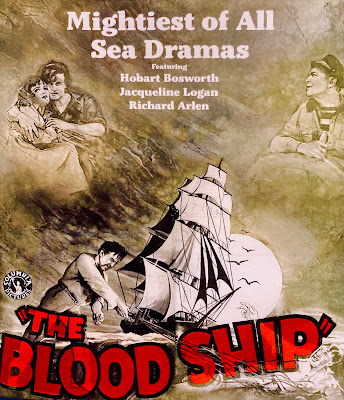 12:00 pm — The Blood Ship (1927, Columbia Pictures, 67 minutes)
Adapted from Norman Springer’s “The Blood Ship” in Everybody’s Magazine, May—August 1922.
Young sailor John Shreve (Richard Arlen) ships out on a freighter skippered by brutish Captain Angus Swope (Walter James), whose beautiful daughter Mary (Jacqueline Logan) has caught John’s eye. Also joining the hard-boiled crew—most of whose members have been shanghaied by Swope and his first mate Fitz (Fred Kohler)—is elderly but still rugged Jim Newman (Hobart Bosworth), an experienced seaman who apparently holds a grudge against the Captain.
For pulpy blood and thunder there’s nothing better than this late silent movie produced by Harry Cohn’s Columbia Pictures, which in 1927 was still basically a Poverty Row concern. As a rule its pictures were turned out cheaply and quickly, but The Blood Ship marked a shift toward more substantial productions featuring well-known actors borrowed from major studios. Hobart Bosworth, who had a preference for films with nautical themes, had been one of the screen’s earliest stars—going back to his 1913 adaptation of Jack London’s The Sea Wolf—but his career was on the downswing when he accepted the role in Blood Ship (which, it should be noted, is reminiscent of but not indebted to the London yarn). Richard Arlen came from Paramount, where he had just scored in the air-war epic Wings and was getting a big buildup from the studio. Jacqueline Logan, beautiful ingenue of many forgettable films, had just finished her scenes as Mary Magdalene in Cecil B. De Mille’s Biblical spectacle King of Kings.
In addition to its strong cast and neatly developed scenario, Blood Ship benefitted from the skillful direction of George B. Seitz, whose career dated back to the influential 1914 serial Perils of Pauline. A past master of movie melodrama, Seitz emphasizes the original story’s uncompromising brutality. Especially noteworthy is his handling of the action-packed climax, one of the most satisfying to be found in any movie of this type. The Blood Ship was both a critical and commercial success, with numerous reviewers calling it the best feature film produced by Columbia to date. For many years it was believed lost, like most silent films, but an original 35mm nitrate print turned up several years ago and immediately underwent restoration. The results were spectacular, as you’ll see in our digital presentation.
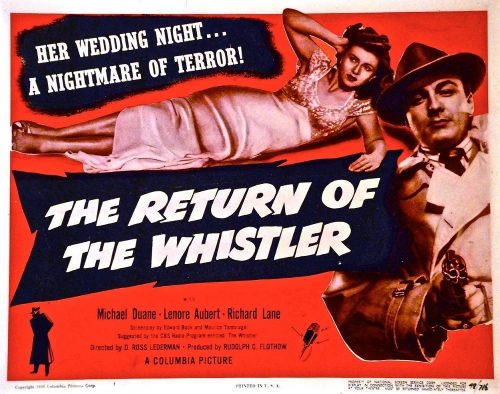
01:15 pm — The Return of The Whistler (1948, Columbia Pictures, 63 minutes)
Adapted from Cornell Woolrich’s “All at Once, No Alice” in Argosy, March 2, 1940.
One evening Ted Nichols (Michael Duane) and his fiancée Alice Dupres (Lenore Aubert) impulsively try to elope but are thwarted when his automobile is mysteriously sabotaged. After checking Alice into a nearby hotel the would-be groom manages to get his car fixed at a 24-hour garage. The following morning Ted returns to the lodge and is told that his betrothed left shortly after he did and never returned. As the mystery deepens he enlists the aid of private detective Gaylord Traynor (Richard Lane), but their combined efforts fail to yield results.
Columbia’s mid-Forties series of “B”-grade thrillers, ostensibly based on the Whistler radio show, maintained a high level of quality throughout. Seven of the eight films starred Richard Dix, a former matinee idol whose star had dimmed considerably. The first three entries were directed by exploitation-minded William Castle near the beginning of his career behind a megaphone. The second, Mark of The Whistler (1944), had been adapted from “Dormant Account,” a Cornell Woolrich novelette originally published in Black Mask. For the final series entry—the only one that didn’t star Dix—producer Rudy Flothow licensed another tale written by pulpdom’s dark poet. “All at Once, No Alice” is quintessential Woolrich and should have made a terrific little movie, but as is Return misses the mark. Most of the blame belongs to director D. Ross Lederman, a specialist in low-budget Westerns and action pictures but somewhat out of his depth when it came to atmospheric crime thrillers of the noir type.
This is not to say Return of The Whistler is a bad film; it’s just so-so, which would be good enough for most low-budget crime movies without big stars but is a distinct disappointment for one adapted from an exemplary Cornell Woolrich tale. The central gimmick of “All at Once, No Alice”—the baffling disappearance of someone whom other characters fallaciously claim never to have seen—had already been used by Hollywood screenwriters numerous times by 1948 (perhaps most effectively in another Woolrich adaptation, 1944’s Phantom Lady). But it could have, and should have, received better than the perfunctory treatment accorded the story by director Lederman and scripters Edward Bock and Maurice Tombragel.
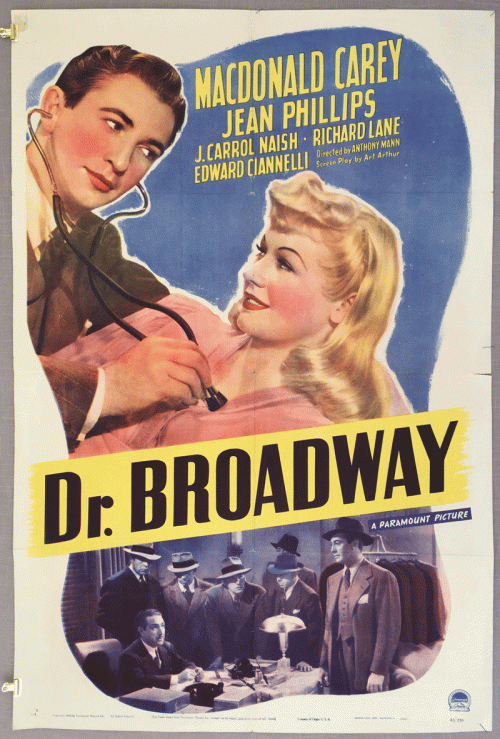
02:30 pm — Dr. Broadway (1942, Paramount Pictures, 68 minutes)
Adapted from Borden Chase’s “Doctor Broadway” in Double Detective, June 1939.
Tim Kane (Macdonald Carey), a Broadway-based medico respected by Great White Way denizens on both sides of the law, hires aspiring actress Connie Madigan (Jean Phillips) as his secretary and assistant. With no one to trust, gangster and ex-con Vic Telli (Eduardo Ciannelli), reportedly suffering from a terminal illness, asks Tim to locate his long-missing daughter Margie Dove (Joan Woodbury), rightful heir to the mobster’s fortune. But Dr. Broadway and his new assistant have competition: Telli’s rival, Jack Venner (J. Carrol Naish), is also after Vic’s money—and will stop at nothing to get it.
Anthony Mann would eventually become a significant film director, with a string of memorable James Stewart Westerns, film noir classics, and epic historical adventures to his credit. But his first half-dozen years behind a megaphone were spent grinding out “B” pictures, most of them modest but interesting crime melodramas. Dr. Broadway was the first of them, and while an amusing, competently made little opus, it has few of the touches that would distinguish Mann’s later, better-known efforts.
Befitting Borden Chase’s story, the film comes off as a hybrid of hardboiled detective fiction and urban comedy of the Damon Runyon variety. The Main Stem’s habitués are played by a veritable Who’s Who of familiar Hollywood character actors active during the Forties, and they behave pretty much the way you would expect if encountering them in the pages of a Runyon story. In his second screen appearance and starring debut, future soap-opera actor Macdonald Carey is somewhat bland but otherwise acceptable. Leading lady Jean Phillips, former stand-in for Ginger Rogers (to whom she bore an uncanny resemblance), is pert and sassy as the Doctor’s Gal Friday. The script by erstwhile newspaperman Art Arthur, who covered the Broadway beat for Brooklyn’s Daily Eagle, adheres to Chase’s pulp yarn with relative fidelity and contains snappy dialogue, some of it lifted from the Double Detective original. Production values are commensurate with the picture’s status as an offering for the bottom half of double bills. Slick and fast-moving, Dr. Broadway will provide exactly the respite you might need after spending hours on your feet in the dealer room and art show.
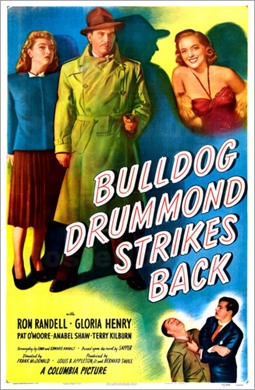
03:45 pm — Bulldog Drummond Strikes Back (1934, 20th Century Pictures, 83 minutes)
Adapted from H. C. “Sapper” McNeile’s “Bulldog Drummond Strikes Back” in Mystery Novels Magazine, Summer 1933.
After attending the wedding of his old friend Algy Longworth (Charles Butterworth), retired Captain Hugh “Bulldog” Drummond (Ronald Colman), walking London’s streets on a dark and foggy night, tries to assist a lost man and enters a house hoping to use the telephone. Stumbling upon the fresh corpse of an elderly man, Hugh quickly leaves to summon the authorities, but upon returning with police in tow he finds the dead man gone. Moreover, the house’s owner, one Prince Achmed (Warner Oland), denies that anyone has died there.
Legendary Hollywood producer Darryl F. Zanuck began his film career in 1922, writing scenarios for dramatic short subjects. Within two years he was installed at the Warner Bros. studio, penning scripts for canine star Rin-Tin-Tin. He earned the trust of mogul Jack Warner and by 1930 was overseeing production. In the early Depression era Zanuck established the studio’s house style, which emphasized snappy, fast-paced melodramas with topical themes and occasional dashes of social consciousness. In 1933, following a series of clashes with Warner over salary cuts imposed on all employees, he quit to form Twentieth Century Pictures with Nicholas Schenck, who secured distribution for their films via United Artists.
Unlike the major concerns, forced to produce dozens of movies each year to supply their affiliated theater chains, Zanuck and Twentieth Century made fewer but better films per annum, borrowing top talent from other production companies. Bulldog Drummond Strikes Back was a sequel to Samuel Goldwyn’s 1929 hit, based on a play by “Sapper” McNeile and Gerald du Maurier and starring silent-era matinee idol Ronald Colman, whose cultured voice matched his distinguished appearance. Zanuck persuaded Colman to reprise his famous role and paired the handsome actor with radiantly beautiful Loretta Young, whom the producer had made one of Warner Bros.’s top box-office attractions.
Nunnally Johnson’s script for Bulldog Drummond Strikes Back jettisoned virtually everything from the 1933 novel and reworked the original plot beyond recognition. Which wasn’t a bad thing; rarely has any cinematic adaptation of a literary work improved so much on its source material. The film has everything: thrills, comedy, romance, mystery, and melodrama. Johnson’s dialogue is witty and charming, with sparing but skillful deployment of the double entendre by deadpan comic actor Charles Butterworth, cast as Drummond’s just-wed pal Algy Longworth. The aforementioned Young makes an irresistible distressed damsel, and Warner Oland (a veteran screen heavy in the process of remaking his persona with regular appearances as avuncular detective Charlie Chan) is sublimely despicable as the villain of the piece. Very few motion pictures can be described as “perfect,” but Bulldog Drummond Strikes Back comes closer to that designation than anything else we’re screening this year. A guaranteed good time.
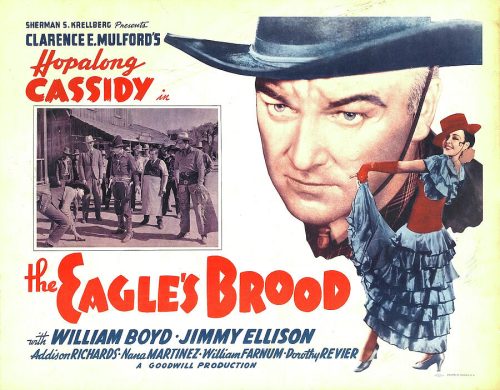
Post-Auction — The Eagle’s Brood (1935, Paramount Pictures, 59 minutes)
Adapted from Clarence E. Mulford’s “Hopalong Cassidy and the Eagle’s Brood” in Short Stories, January 10—February 25, 1932.
When notorious but retired Mexican bandit El Toro (William Farnum) learns that his son and daughter-in-law have been murdered, and that his young grandson has escaped the killers, he leaves the safety of his hidden hacienda to find the boy and wreak vengeance. An unexpected turn of events finds Hopalong Cassidy (William Boyd) and his sidekick Johnny Nelson (James Ellison) working on the old man’s behalf, having promised to locate the child and bring the murdering outlaws to justice.
Clarence Mulford’s 1932 novel was a pulpwoody forerunner of much later comic books such as X-Men, The Avengers, and Justice League of America in that it teamed Hoppy and the Bar-20 bunch with a handful of heroes from the author’s non-series yarns. Their adversaries, a group of outlaws headed by the ruthless Big Henry (odd name for a Western villain, that), were seriously outmatched, a plot flaw that screenwriters Doris Schroeder and Harrison Jacobs sidestepped by pitting the bad guys against Hoppy and Johnny alone. Second of the 66 Hopalong Cassidy feature films made between 1935 and 1948, The Eagle’s Brood was shot in 12 days for a scant $64,000—one thousand dollars under budget but far less than major-studio “A” Westerns cost in those days. Most of the footage was lensed on location in and around Kernville, a small town roughly 160 miles north of Hollywood and located at the southern end of the Sierra Nevada mountain range. Like other early entries in this series, Eagle’s Brood has rough edges than director Howard Bretherton couldn’t smooth out with only two weeks for principal photography. William Boyd still speaks with an exaggerated Western accent (an affectation he would drop after his first couple years in the starring role) and Jimmy Ellison seems too polished for a young cowhand. But the film has excellent cinematography (by Archie Stout, future Oscar winner for The Quiet Man) and moves briskly enough to make a pleasant diversion after what promises to be a lengthy Friday-night auction.
Saturday
10:00 am — Buck Rogers in the 25th Century (1934, John F. Dille Co. and Action Film Company, 10 minutes app.)
Based on characters appearing in Philip Nowlan’s “Armageddon 2419 A.D.” in Amazing Stories, August 1928.
Buck Rogers (John F. Dille Jr.), having spent five centuries in suspended animation, becomes a Captain of the Interplanetary Battle Fleet, whose technological superiority has been guaranteed by the inventions of brilliant Dr. Huer (Harlan Tarbell). Young Buddy Deering, brother of Buck’s sweetheart Wilma, learns that the fearsome Tiger Men of Mars are headed for Earth, bent on conquest. Buck leads a fleet of spaceships to meet the invaders in outer space.
This short film, screened in 1934 at the Chicago World Fair (also known as the Century of Progress International Exposition), was produced by the locally based John F. Dille Co., which had purchased rights to Philip Nowlan’s two Amazing Stories novellas. Changing the main character’s first name from “Anthony” to “Buck,” Dille had launched a comic strip in 1929 and a radio program in 1932. His company also came up with a dazzling array of licensed products—toy ray guns, rocket ships, futuristic helmets and costumes, etc.—which were sold both at retail locations and at the Fair itself. You can see just about all of ‘em in this amateurish, unintentionally hilarious little promotional film, for which the expression “so bad it’s good” might well have been coined. Take our word for it, you won’t laugh so hard during any other ten minutes this weekend.
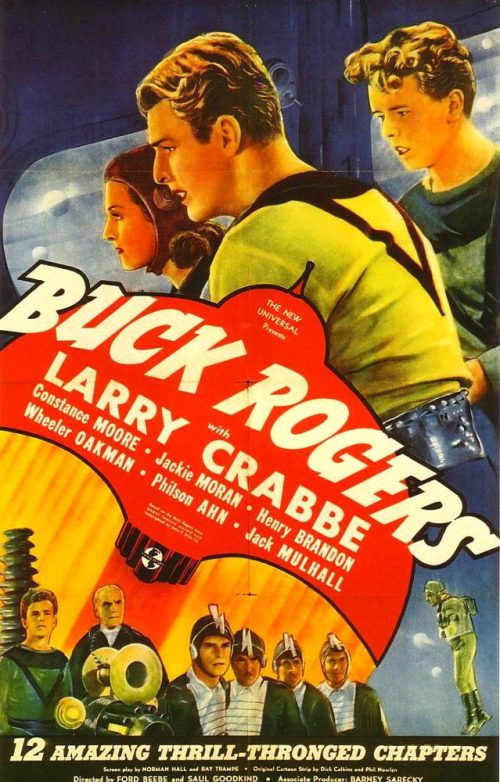
10:15 am — Buck Rogers (1939, Universal Pictures serial, 240 minutes)
Based on characters appearing in Philip Nowlan’s “Armageddon 2419 A.D.” and “The Airlords of Han” in Amazing Stories, issues August 1928 and March 1929 respectively.
After being in suspended animation for nearly 500 years, American aviators Buck Rogers (Larry “Buster” Crabbe) and Buddy Wade (Jackie Moran) are revived and taken to a hidden city populated by “rebels”—the only free people left on Earth, which has been subjugated by a ruthless dictator. Buck and his young pal join their new friends in attempting to forge an alliance with sympathetic Saturnians and hopefully win liberation from the tyrannical Killer Kane (Anthony Warde).
The success of Universal’s Flash Gordon serials (the 1936 opus being the studio’s second most profitable film that year) prompted company executives to license screen rights to another science-fictional comic strip, the John F. Dille syndicate’s Buck Rogers in the 25th Century. Since Olympic swimmer-turned-actor Larry “Buster” Crabbe had done so well as Flash, he was naturally cast as Buck—although there wasn’t an iota of difference in the way he portrayed both heroes, except that he didn’t have to dye his natural brunet hair to play Rogers. The script for Buck Rogers used most of the characters then prominent in both comic strip and radio show, although the plot strayed considerably from Philip Nowlan’s two Amazing Stories novelettes.
When Buck Rogers began principal photography in September 1938, Universal was in serious financial trouble. Newly installed president Nate Blumberg and production chief Clifford Work had been instructed by chairman of the board J. Cheever Cowdin to cut expenses wherever possible. Since Flash Gordon’s Trip to Mars, released earlier that year, had gone significantly over-budget, Buck Rogers producer Barney Sarecky and director Ford Beebe were warned not to exceed the serial’s $177,200 budget. They did, mostly due to delays shooting the many scenes requiring special effects, but the end result was undeniably impressive. Beebe was especially proud of the production value he and his team had gotten into the chapter play, and chafed when Universal executives failed to acknowledge much less appreciate his considerable achievement.
If you’ve seen any of the Flash Gordon serials, Buck Rogers will look familiar. It boasts set design, costume design, story structure, and special effects similar to those found in the earlier chapter plays. The pace is fast and there’s plenty of action, divided between Earth and Saturn (which looks surprisingly warm and sunny, and seems to have plenty of oxygen for earthlings to breathe). Although we’re running all 12 chapters in one marathon session, the variety of location and incident will make the 240-minute running time pass swiftly.
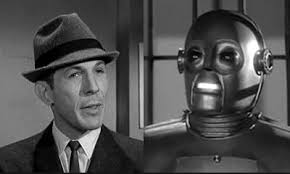
02:30 pm — I, Robot (1964 episode of The Outer Limits, United Artists Television, 51 minutes)
Adapted from “Eando” (Otto) Binder’s “I, Robot” and “The Trial of Adam Link” in Amazing Stories, issues January 1939 and July 1939 respectively.
When elderly inventor “Doc” Link (Peter Brocco) is found dead under strange circumstances, suspicion falls on his latest creation, a robot named “Adam.” Link’s daughter Nina (Marianna Hill) persuades cynical lawyer Thurman Cutler (Howard Da Silva) to defend Adam at the trial, which is covered by reporter-turned-ally Judson Ellis (Leonard Nimoy).
In the years immediately before Star Trek’s 1966 debut, the most popular science-fiction show on television was ABC’s The Outer Limits (1963-65). Producer Leslie Stevens and his writing staff adapted a good number of SF books and magazine stories by such genre standbys as Harlan Ellison and Clifford Simak, with Psycho scripter Joseph Stefano (who helped produce many episodes) contributing original scripts on a regular basis.
Combining Otto Binder’s first two Adam Link stories into one hour-long TV episode was a no-brainer, and Robert C. Dennis’s teleplay arguably improved on them. Dennis invented the attorney character played by distinguished actor Howard Da Silva; beefed up the role of reporter Judson Ellis (who barely appeared in Binder’s original and had no name); and changed the sex of Professor Link’s adult child from son to daughter, to add a hint of romance. Perhaps most meaningfully, Dennis threw out the ending of “Trial of Adam Link” and substituted one considerably more poignant and ironic. For our money “I, Robot” is among the most satisfying installments of the original Outer Limits run.
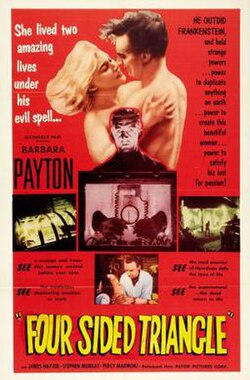
03:30 pm — Four Sided Triangle (1953, Hammer Films, 81 minutes)
Adapted from William F. Temple’s “The 4-Sided Triangle” in Amazing Stories, November 1939.
Scientists and lifelong friends Bill (Stephen Murray) and Robin (John Van Eyssen). Since boyhood, both have competed for the attentions of Lena (Barbara Payton), a beautiful girl whose family moves away. Burying themselves in their work, the two men perfect an invention they call “the Reproducer,” which can duplicate physical objects down to the tiniest detail. Lena returns to the village as a grown woman, more gorgeous than ever. While fond of both scientists, she falls in love with Robin but allows Bill to create an exact duplicate of herself with the Reproducer. The ensuing complications lead to tragedy.
The only notable yarn penned by British science-fiction writer William Temple (who as a young man shared a flat with Arthur C. Clarke), “4-Sided Triangle” first appeared in print as a novelette in the November 1939 issue of Amazing Stories. While serving with Her Majesty’s armed forces during World War II, Temple used his brief but precious spare time to expand the story into a novel, which was published between hard covers by John Long in 1949. Hammer Films producer Michael Carreras purchased screen rights to the book in early 1952 and filming began that August. A low-budget production shot in five weeks, it starred beautiful American actress Barbara Peyton, a high-school dropout and former model whose alcohol-fueled antics as a Hollywood party girl won her more notoriety than any of her screen performances. Her affair with “B”-movie leading man Tom Neal, while she was engaged to early-talkie star Franchot Tone, made international headlines when Neal beat the older actor so badly that he wound up in a coma. Tone forgave Payton and married her in 1951, only to divorce her the following year after learning she had continued her affair with Neal.
Michael Carreras hired her to star in Four Sided Triangle (directed by another Hammer veteran, Terence Fisher) believing that the lurid publicity she had received would be an asset at theater box-offices. The resulting film, we must admit, is rather tedious and fails to exploit fully the premise and complexities of Temple’s novel. But it’s not without interest, and you’ll need only one look at the ravishing, vivacious Payton to understand why grown men fought over her. The buxom blonde’s movie career faded not long after she returned from England, and she was reduced to prostituting herself before dying of heart and liver failure at age 39.
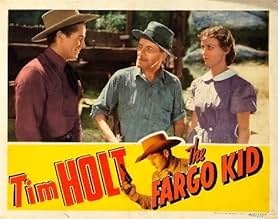
Post-Auction — The Fargo Kid (1940, RKO Radio Pictures, 63 minutes)
Adapted from W. C. Tuttle’s “Sir Piegan Passes” in Adventure, August 10, 1923.
Set afoot in the desert southwest when his horse breaks a leg, the Fargo Kid (Tim Holt) is trudging toward Micaville when he encounters Deuce Mallory (Paul Fix), a gunman also headed for the small Arizona town. Mallory attempts to kill the Kid, who turns the tables on him and rides off on Deuce’s copper sorrel. Upon reaching town Fargo is mistaken for the hired killer when Mallory’s distinctive horse is recognized. Paid five thousand dollars by oily Nick Kane (Cy Kendall), a schemer who wants him to slay prospector Caleb Winters (Paul Scardon), the Kid finds himself in a dangerous game but elects to play until the last hand is dealt.
Filmed twice before (as a 1928 silent titled Man in the Rough and a 1933 talkie titled The Cheyenne Kid), Tuttle’s non-series yarn written for Adventure magazine is altered by screenwriters Morton Grant and Arthur V. Jones just enough to make an effective vehicle for 21-year-old Tim Holt, who had just replaced George O’Brien as RKO’s resident “B”-Western star. Although Tim hit his peak in the post-World War II years, The Fargo Kid offers ample evidence of the considerable promise he eventually fulfilled. Boyishly handsome and convincingly athletic (he was already among the best horsemen then riding the Hollywood range), young Holt delivers an assured, commanding performance even though surrounded by veteran character actors with decades of experience. The story unfolds smoothly and at a rapid clip, with enough action to keep auction-weary conventioneers awake throughout the 63-minute running time.

